

4.8 Ratings on Google
Quality work for a fair price
New Construction Forced Air Heating in Woodland Park, CO
Quality Service without unnecessary upselling.
We respect your decisions by giving you clear options.
Local Experience serving Teller & Park County mountain homes
Building a new home or commercial space in Woodland Park means planning for long heating seasons, cold nights, and thin mountain air. Woodland Plumbing, Heating & Air Conditioning designs and installs forced air heating systems for new construction throughout Teller and Park Counties. Our team has more than 20 years of experience with mountain homes, so we know what equipment holds up at roughly 8,500 feet. We work with you from early planning through final inspection.
Getting the heating system right during construction costs far less than fixing it later. Duct runs, equipment location, and venting are much easier to plan before walls and ceilings close up. We walk you through your options so you can choose a system that fits your build and your budget.
Our Services

Contact Us
- This site is protected by reCAPTCHA


What Your Neighbors Are Saying About Us

When you’re on time, honest, friendly and competent, and then fix it right the first time you’re worth five stars. We have hired them for both plumbing and heating and they still get the first call.
Malcolm M.
Mark the owner of the company does amazing work. They are thorough, timely, and do what they say they will. I’ve never dealt with a more professional plumbing/hvac company other than this one. They are simply the best!
Scott T.
Woodland Plumbing responded to my phone message quickly and was able to arrange a service call that day. The technician was very courteous and took care of my problem without an unnecessary or unexpected repairs. Their fee for this prompt service was extremely fair. No surprises.
Bill Q.
Forced Air Heating Systems We Install in New Builds
We install forced-air equipment sized and set up for high-elevation homes.
- High-efficiency gas furnaces
- Propane furnaces for rural lots
- Electric furnaces
- Dual fuel heat pump systems
- Two-stage and variable-speed units
- Whole-home humidifiers
Every gas furnace we install in the area is adjusted for altitude. Thinner air changes how fuel burns, so equipment needs proper setup to run cleanly and safely. We also recommend humidifiers for many new builds, since dry Colorado air can make a home feel colder and dry out new trim and flooring.
Load Calculations and System Sizing for New Construction
Correct sizing starts with a load calculation, not a guess. We use Manual J calculations to determine how much heat each room needs based on square footage, insulation, window placement, and building orientation. In Woodland Park, that math has to account for long winters and nights that drop below freezing well into spring and fall.
An oversized furnace short-cycles, wears out faster, and leaves rooms with uneven temperatures. An undersized system runs nonstop on the coldest days and still struggles to keep up. Both problems cost the owner money for years.
Altitude matters here, too. Gas furnaces lose heating capacity at high elevation, so the output on the label is not what you get at 8,500 feet. We factor that loss into equipment selection so the system delivers the heat the home actually needs.
Ductwork Design and Installation
A furnace is only as good as the ductwork carrying its heat. We design duct systems using Manual D principles, sizing supply and return runs so air moves quietly and evenly to every room. Good design also keeps the blower from working harder than it should, which helps the equipment last longer.
New construction gives us the chance to route ducts through conditioned space whenever possible. Ducts in unheated crawlspaces or attics lose heat quickly during a mountain winter. When those runs can’t be avoided, we seal and insulate them to limit heat loss.
We seal joints and test for leaks before drywall goes up. Registers and returns are placed to match the layout of the home, including lofts, vaulted ceilings, and large windows, which are common in mountain builds. The result is a home that heats evenly from the main floor to the upper level.

Working With Builders, Contractors, and Homeowners
We know a delayed heating contractor can hold up an entire project, so we plan our work around your build schedule. Builders and general contractors can count on clear communication, accurate bids, and crews who show up when they say they will. We coordinate with framers, electricians, and plumbers to avoid conflicts in mechanical chases and ceiling spaces.
For homeowners building custom homes, we take time to explain equipment choices, efficiency ratings, and long-term operating costs. We lay out the options and let you make the call. Our goal is a system that fits the way you plan to live in the home.
We complete rough-in during framing and return for trim-out and startup once the home is ready. Before we leave, we test the system, check gas pressure and combustion, and show the owner how to use the thermostat and change filters.
Code Compliance, Permits, and Inspections
New heating installations must meet building and mechanical codes and pass inspection before a home can be occupied. We pull the required permits and schedule inspections with the local building department. Our team stays current on the codes enforced in Teller and Park Counties, including requirements for combustion air, venting, and gas piping.
Mountain homes also face challenges like heavy snow that can block vent terminations. We plan vent locations to avoid snow buildup and drifting. Getting these details right the first time keeps inspections on track and your project moving.
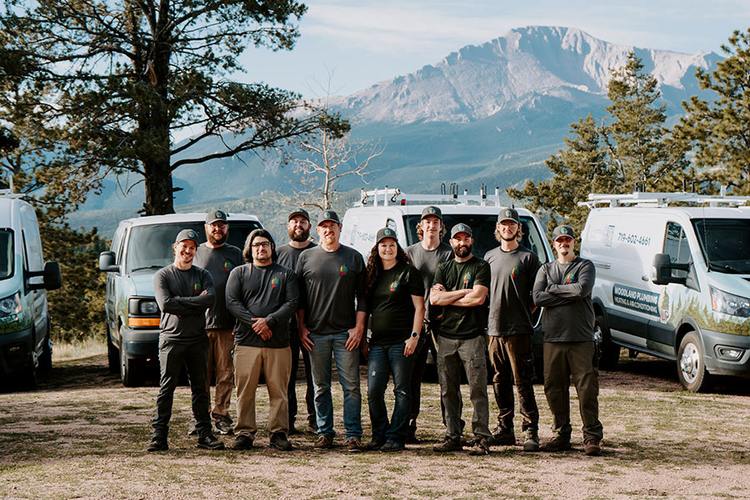
Why Choose Woodland Plumbing, Heating & Air Conditioning
Builders and homeowners across the area trust our team for new-construction heating.
- 20+ years in Teller County
- High-altitude heating specialists
- Fair, transparent pricing
- Options, not pressure
- Licensed and insured
- BBB accredited
- Best of Teller County winner
- 4.8 stars from 100+ reviews
Frequently Asked Questions
When should I bring an HVAC contractor into my new build?
As early as possible, ideally during the planning stage. This lets us plan duct runs and equipment space before framing starts.
Does altitude affect furnace sizing?
Yes. Gas furnaces lose heating capacity at high elevations, and we account for that loss when selecting equipment.
Should I choose a natural gas or propane furnace?
It depends on what is available at your property. Many rural lots in Teller and Park Counties rely on propane, and we install both propane and natural gas.
Do you handle permits and inspections?
Yes. We pull permits and schedule inspections for every new construction installation.
Can I add air conditioning later?
Yes. We can size and design the ductwork so a cooling system can be added down the road without major changes.